


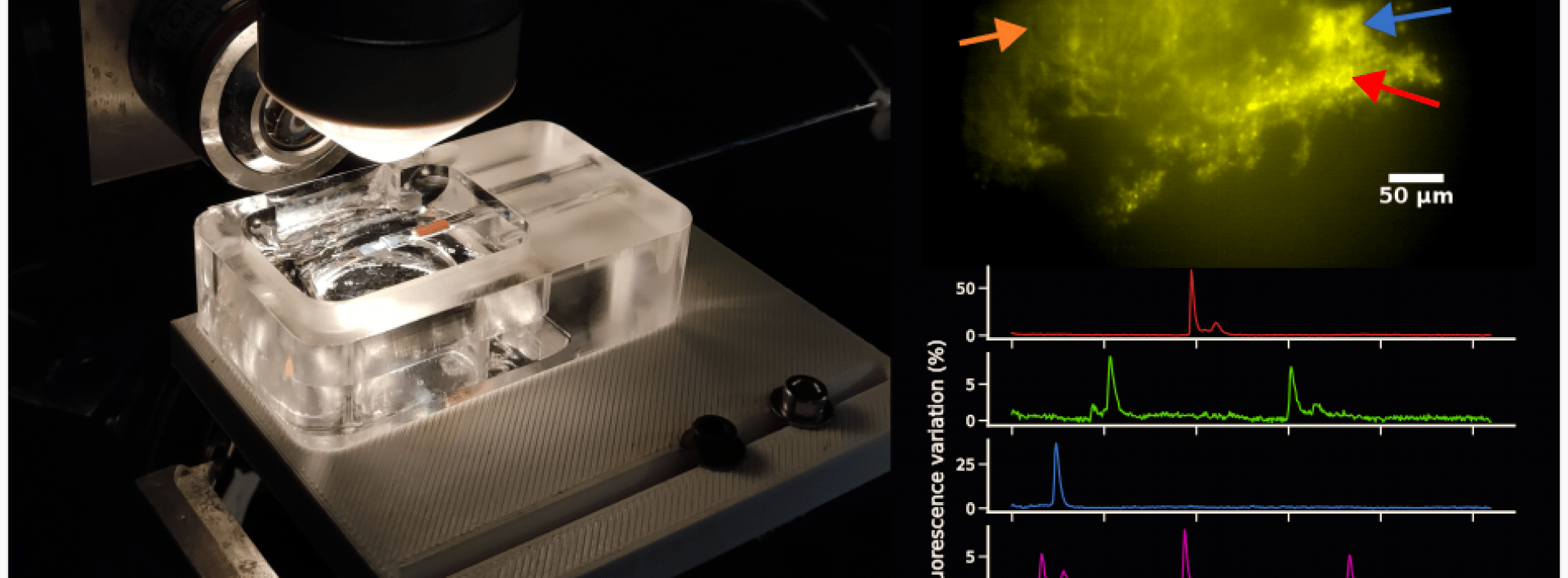
Studying functional brain development with 3D brain organoids
- Contact: Antoine Hubert
Our lab uses 3D brain organoids, tiny, lab-grown models of the human brain, to study how neurons develop and form networks. These organoids mimic the early stages of brain development, allowing us to explore how neural stem cells grow and how excitatory and inhibitory neurons connect.
To analyse these complex structures, we use advanced imaging techniques, including:
- High-resolution light-sheet microscopy to capture detailed 3D images of living organoids over time.
- Calcium imaging to visualize neuronal activity and understand how networks function.
- Adaptive optics to improve image clarity and resolution, especially in dense or scattering tissues.
- Image analysis and segmentation to identify and track individual cells and their activity.
Our Goals
We aim to understand how the brain builds its functional networks during development, focusing on long-range connections, interneuron migration, and synaptic plasticity. To achieve this, we use two complementary approaches:
- Multi-area brain organoids (assembloids) to model interactions between different brain regions.
- Optogenetics to precisely control and study the activity of specific neuronal populations.
By tracking the formation and adaptation of these networks, we seek to uncover fundamental principles of brain development. This work not only advances our knowledge of neuroscience but also provides insights into neurodegenerative diseases.
Additionally, we are exploring the use of generative models to simulate and predict how neuronal networks organize and evolve over time, bridging experimental data with computational neuroscience.
Main Collaborators:
- Institute of Reconstructive Neurobiology (Bonn, Germany): C. Hayn, O. Brüstle
- Laboratoire Jean Perrin (Paris, France): V. Bormuth, G. Debrégeas, M. Dommanget-Kott
Open Positions: We are looking for motivated students for an M2 Internship: Developing adaptive optics tools for functional imaging of brain organoids (with the possibility to continue in PhD).